
Have you ever found yourself defending someone who keeps hurting you?
Maybe they lie, manipulate, ignore your feelings, or make you question your reality — yet somehow, walking away feels impossible.
You know something feels wrong. Your friends may have warned you. Deep down, you might even know the relationship is hurting you.
And yet, a part of you still hopes they’ll go back to the version of themselves you first fell for.
If that sounds painfully familiar, you may not just be “in love.”
You could be trapped in something psychologists call trauma bonding — an emotional attachment that forms through cycles of affection, pain, confusion, and emotional dependency and signs of trauma bonding are often hard to recognize while you’re inside the relationship.
In relationships involving narcissistic behavior, trauma bonding can feel disturbingly convincing. The highs feel intoxicating. The lows feel unbearable. And somewhere in between, you begin confusing survival with love.
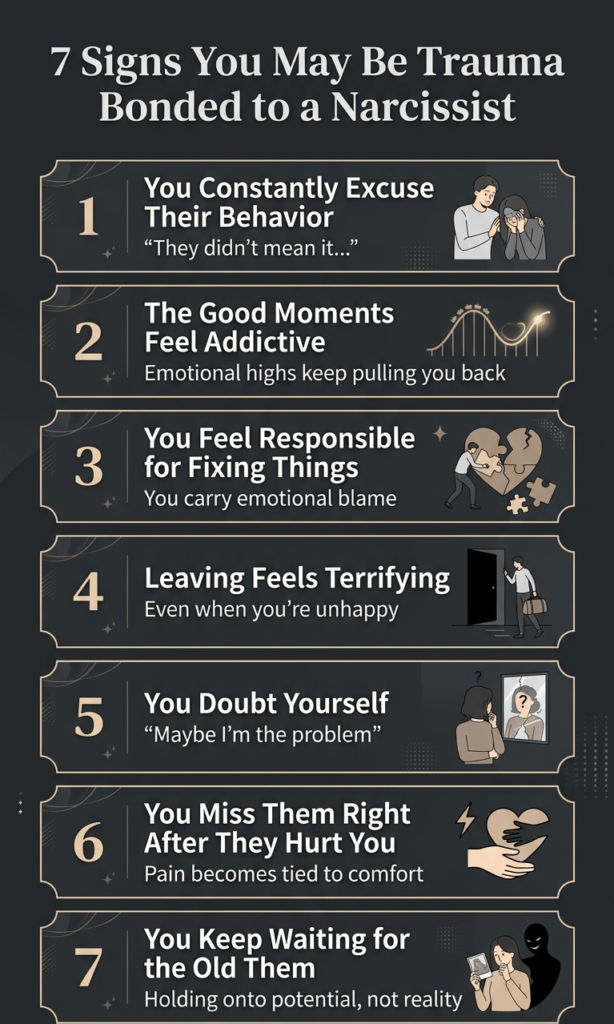
Here are 7 signs you may be trauma bonded to a narcissist — without fully realizing it.
What Are the Signs of Trauma Bonding?
A trauma bond is a strong emotional attachment that develops through repeated cycles of emotional pain followed by moments of relief, affection, or validation.
In simpler terms:
Someone hurts you… then comforts you.
They emotionally withdraw… then suddenly become loving again.
They break your trust… then convince you they’re changing.
Over time, your brain starts clinging to those brief moments of connection — even when the relationship itself becomes damaging.
This pattern is especially common in narcissistic relationships because emotional unpredictability creates dependency.
If you’ve already experienced subtle manipulation in a relationship, you may also recognize signs discussed in our article on Signs of Covert Narcissism in Relationships — The Abuse You Can’t Quite Name.
1. You Keep Excusing Their Hurtful Behavior
You know they hurt you.
But somehow, you always find yourself explaining it away.
Maybe you tell yourself:
“They had a stressful day.”
“They didn’t mean it.”
“They’ve had a difficult childhood.”
Compassion is healthy. Constant self-abandonment is not.
In a trauma bond, you slowly begin prioritizing their struggles over your emotional safety.
The result?
You stop asking:
“Why are they treating me like this?”
And start asking:
“What can I do better?”
That shift is often the beginning of emotional entrapment.
2. The Good Moments Feel Addictive
One of the most confusing parts of trauma bonding is this:
The relationship is painful — but the good moments feel incredibly intense.
After days of distance, criticism, or emotional coldness, they suddenly become affectionate again.
They apologize.
They say all the right things.
They make you feel deeply wanted.
For a moment, it feels like the relationship is finally healing.
But then the cycle returns.
This emotional whiplash can become psychologically powerful because unpredictability often strengthens emotional attachment.
You begin chasing the “good version” of them.
The version you met in the beginning.
The version that now feels harder and harder to reach.
3. You Feel Responsible for Fixing the Relationship
Do you constantly feel like:
“If I communicate better, maybe things will improve.”
“If I become more understanding, they’ll stop hurting me.”
“If I just love them enough, things will go back to normal.”
Trauma bonding often creates a dangerous illusion:
That you are responsible for repairing damage you didn’t create.
Healthy relationships involve accountability from both people.
In narcissistic dynamics, however, blame quietly shifts onto one person — until you’re carrying emotional weight that was never yours.
If arguments somehow always end with you apologizing, despite being hurt first, this may connect with patterns discussed in Reactive Abuse — Why Narcissists Make You Look Like the Abuser.
4. Leaving Feels Terrifying — Even When You’re Miserable
This is one of the strongest signs.
You know the relationship is draining you.
You feel anxious, confused, emotionally exhausted.
But the idea of leaving feels unbearable.
Why?
Because trauma bonds often create emotional dependency.
You may fear:
- being alone
- losing the version of them you still hope exists
- starting over
- feeling guilty
- never finding love again
Strangely, the relationship can feel both unsafe and emotionally necessary at the same time.
That contradiction confuses many people.
But it is extremely common in trauma-bonded relationships.

5. You Constantly Doubt Yourself
You stop trusting your own instincts.
You wonder:
“Am I overreacting?”
“Maybe I’m too sensitive.”
“What if I’m actually the problem?”
Over time, repeated manipulation can slowly distort your confidence in your own reality.
Especially if your partner dismisses your concerns, rewrites arguments, or twists facts.
This emotional confusion is often linked to narcissistic gaslighting, where someone gradually makes you question your perception of events.
You may recognize similar behaviors in 7 Signs of Narcissistic Gaslighting in a Relationship.
When you stop trusting yourself, leaving becomes much harder.
Because now, you’re not just questioning them.
You’re questioning yourself.
6. You Miss Them Most Right After They Hurt You
This one surprises many people.
After an argument, emotional withdrawal, or painful incident…
You suddenly crave closeness from the same person who hurt you.
You want reassurance.
Affection.
Comfort.
Attention.
It feels confusing.
Why would someone become your source of comfort after causing the pain?
Because trauma bonds often condition people to seek relief from the very person creating emotional distress.
The cycle quietly becomes:
Pain → relief → attachment → pain again.
Over time, this can start feeling strangely normal.
Even when it’s deeply unhealthy.

7. You Keep Waiting for the Relationship to “Go Back” to the Beginning
You remember how things used to feel.
The attention.
The affection.
The promises.
The intense connection.
And you keep holding onto hope that version will come back.
So you stay.
You forgive.
You wait.
You try harder.
But here’s the painful truth:
Sometimes, the beginning was not the whole story.
Sometimes, it was the hook.
And what keeps people stuck is not necessarily the present relationship — but the memory of what they desperately want it to become again.
Why Trauma Bonding Feels So Hard to Recognize
Trauma bonds rarely feel obvious while you’re inside them.
Because no one wakes up thinking:
“I want to stay in a painful relationship.”
Instead, it happens gradually.
One apology.
One hopeful moment.
One emotional comeback at a time.
And eventually, confusion starts feeling normal.
Loyalty starts replacing self-protection.
And love becomes tangled with pain.
Recognizing the pattern is often the hardest part.
But it can also be the beginning of clarity.
If several of these signs felt familiar, it may be worth asking yourself a difficult but important question:
Are you holding onto who they are — or who you keep hoping they’ll become?
Recognizing the signs of trauma bonding can be the first step toward emotional clarity.
You deserve relationships that feel safe, consistent, and emotionally steady — not relationships that leave you constantly questioning your worth.
If this topic resonated with you, you may also want to read:
- Reactive Abuse — Why Narcissists Make You Look Like the Abuser
- 7 Signs of Narcissistic Gaslighting in a Relationship
- Signs of Covert Narcissism in Relationships — The Abuse You Can’t Quite Name
For further reading, these evidence-based resources offer useful information on trauma bonding and relationship dynamics:
- The National Domestic Violence Hotline: https://www.thehotline.org/
- Psychology Today (Trauma Bonding Explained): https://www.psychologytoday.com/us