
Imaagine living in a town where the ocean provides everything.
It feeds your family, supports your livelihood, and shapes everyday life.
Then, without warning, people begin to stumble while walking. Children are born with severe disabilities. Birds fall from the sky. Cats spin in circles before collapsing. Doctors struggle to explain the growing number of strange neurological illnesses.
For years, no one suspected that the source of the disaster was the very water that had sustained the community for generations.
This is the story of Minamata Disease—one of history’s most devastating examples of industrial pollution, corporate negligence, and environmental contamination.
A Thriving Coastal Town
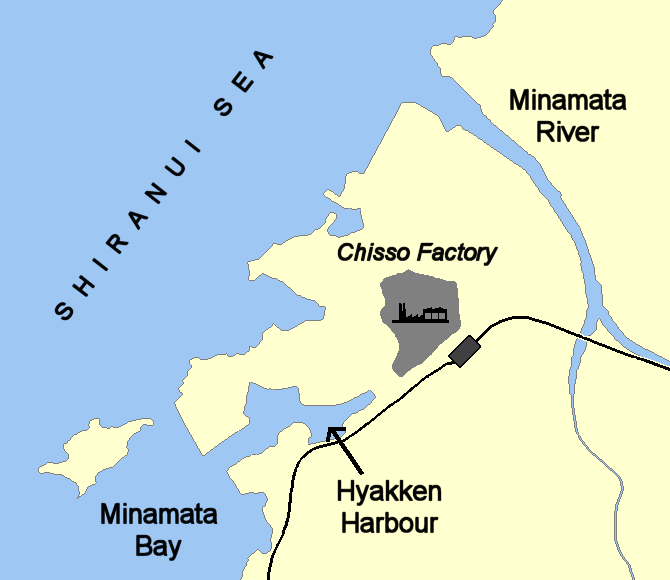
Minamata is a coastal city on Japan’s western island of Kyushu.
For generations, fishing formed the backbone of the local economy. Families relied on seafood not only for income but also as a staple of daily life.
In the early twentieth century, another industry arrived.
The Chisso Corporation established a chemical factory that became one of the town’s largest employers. Producing fertilizers, plastics, and industrial chemicals, the factory helped transform Minamata into a prosperous industrial community.
Few imagined that prosperity carried an invisible cost.
An Invisible Poison Enters the Sea
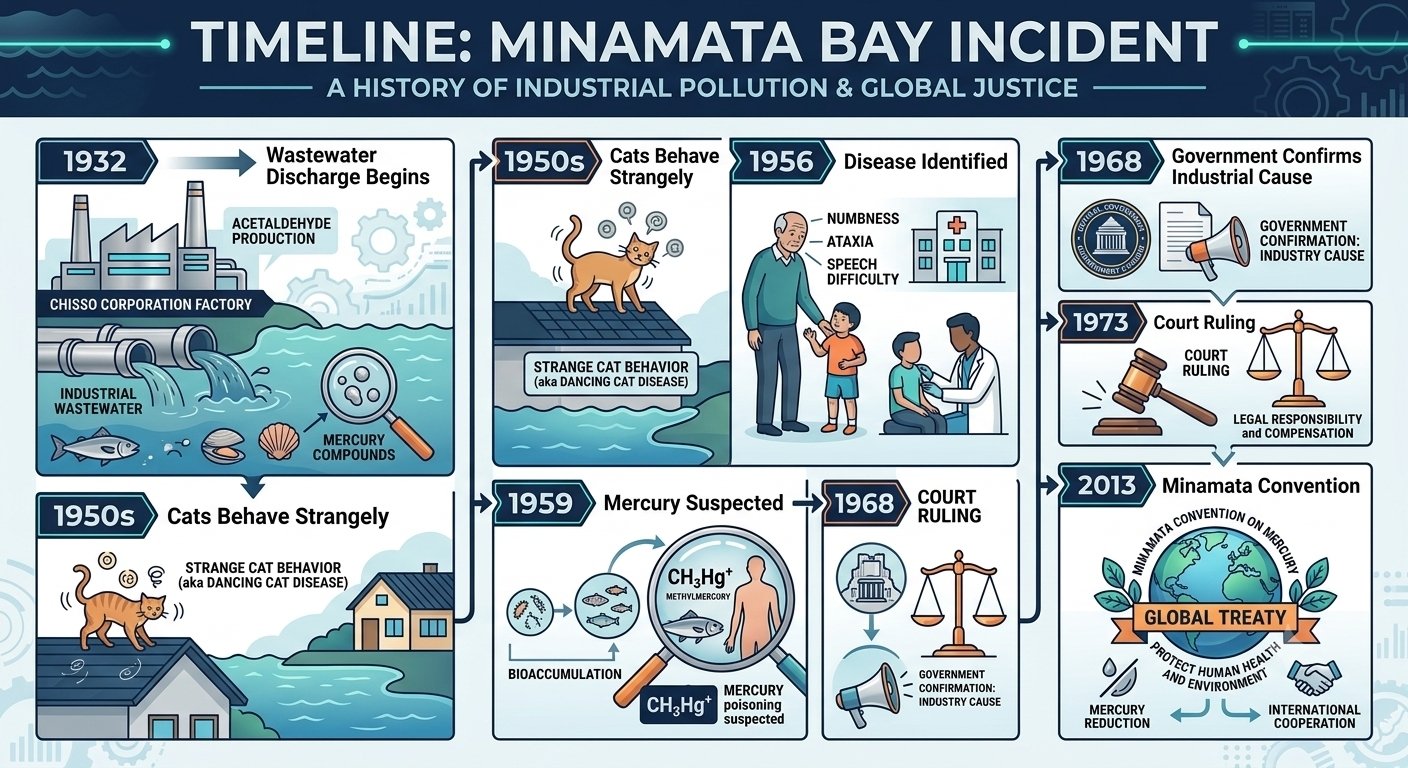
Beginning in the 1930s, wastewater from the factory was discharged into Minamata Bay.
Among the waste was methylmercury, a highly toxic form of mercury created during industrial chemical production.
Unlike many pollutants, mercury does not simply disappear.
Tiny marine organisms absorbed it.
Small fish ate those organisms.
Larger fish consumed the smaller fish.
Eventually, the mercury reached the people who depended on seafood every day.
The contamination quietly moved through the food chain for decades before anyone understood what was happening.
The First Signs
By the early 1950s, local residents began noticing unusual behavior in animals.
Cats staggered through the streets, lost coordination, and suffered violent convulsions. Some became so disoriented that locals described them as “dancing cats.”
Birds fell from the sky.
Fish floated lifeless near the shore.
Soon, humans developed similar symptoms.
People experienced:
- numbness in their hands and feet
- difficulty speaking
- loss of balance
- impaired vision
- hearing problems
- muscle weakness
As the disease progressed, some patients lost the ability to walk, eat, or communicate.
Many died.

A Medical Mystery
Doctors struggled to understand the illness.
On May 1, 1956, local physicians officially reported an unknown neurological disease affecting residents around Minamata Bay.
This date is now recognized as the official discovery of Minamata Disease.
Researchers investigated infectious diseases, nutritional deficiencies, and numerous environmental causes before evidence increasingly pointed toward mercury poisoning.
Corporate Denial and Delayed Action
Evidence linking the factory to the contamination accumulated over time.
Yet meaningful action came slowly.
Wastewater continued to enter the bay while scientific investigations and public debate continued.
Residents demanded answers.
Many believed industrial pollution was responsible.
The company challenged the conclusions, and disputes over responsibility delayed compensation and cleanup efforts.
As years passed, more people became ill.
The Children Who Never Had a Choice
Perhaps the most heartbreaking victims were children exposed before birth.
Pregnant women who showed few symptoms sometimes gave birth to babies with severe neurological damage.
Known today as congenital Minamata disease, these children faced lifelong disabilities caused by mercury exposure during fetal development.
The tragedy revealed that environmental pollution could affect not only those directly exposed, but also future generations.
Justice Comes Slowly
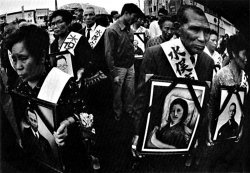
Victims organized, protested, and pursued legal action.
Court cases eventually concluded that the company bore responsibility for the contamination.
Compensation programs followed, though many victims argued they came far too late.
Some people fought for decades to gain official recognition.
The disaster became one of Japan’s most significant environmental justice movements.

How Minamata Changed Environmental Protection
The disaster transformed how governments viewed industrial pollution.
Its legacy includes:
- stronger industrial wastewater regulations
- stricter environmental monitoring
- greater corporate accountability
- improved public health protections
- international cooperation on mercury pollution
In 2013, more than 140 countries adopted the Minamata Convention on Mercury, a global treaty designed to reduce mercury pollution worldwide.
The town’s name became a permanent reminder of the consequences of uncontrolled industrial contamination.
Why Minamata Still Matters
Minamata is not only a story about mercury.
It is a reminder of what can happen when economic progress outpaces environmental responsibility.
The disaster showed how pollution can remain hidden for years before its effects become impossible to ignore.
It also demonstrated that scientific warnings, community voices, and environmental monitoring play a critical role in protecting public health.
Although the events began decades ago, Minamata continues to shape discussions about industrial pollution around the world.
When Industry Outpaces Responsibility
History rarely repeats itself in exactly the same way, but it often follows familiar patterns.
Innovation creates opportunity.
Industry drives economic growth.
When oversight fails, however, the consequences can spread far beyond factory walls.
Readers interested in similar stories may also enjoy:
- The Radium Girls: How a “Miracle” Material Poisoned an Entire Workforce — how radioactive paint transformed workplace safety.
- Love Canal: The Neighborhood Built on Toxic Waste — when buried chemical waste devastated an American community.
- The Leaded Gasoline Scandal: How One Invention Poisoned the World — how a fuel additive contaminated generations.
- How Asbestos Became One of History’s Biggest Public Health Disasters — when a trusted material became a global health crisis.
Conclusion
For generations, the people of Minamata trusted the sea that had always sustained them.
Instead, it carried an invisible poison that reshaped countless lives.
Today, Minamata stands as one of history’s clearest warnings that environmental disasters often begin quietly—long before their consequences become visible.
Its legacy reminds us that scientific evidence, transparency, and accountability are essential safeguards whenever industrial progress meets public health.