Imagine buying a home in what seems like the perfect neighborhood.
The streets are quiet.
Children ride their bikes after school.
Families plant gardens and settle into what they hope will be a safe future.
Then strange things begin happening.
After heavy rain, dark substances appear in backyards. Chemical odors drift through the neighborhood. Children return home with mysterious burns after playing outside.
At first, these incidents seem isolated.
Then more reports emerge.
More illnesses.
More questions.
Eventually, residents uncover a horrifying truth:
Their neighborhood had been built on top of thousands of tons of toxic industrial waste.
What followed would become one of the most infamous environmental disasters in American history.
This was Love Canal.
What Was Love Canal?
Long before it became a national scandal, Love Canal was simply an unfinished construction project.
In the late nineteenth century, entrepreneur William T. Love envisioned a canal connecting parts of Niagara Falls, New York. The project promised economic growth and industrial development.
The plan never succeeded.
Financial difficulties and changing economic conditions halted construction before the canal could be completed.
The partially dug canal remained abandoned for decades.
What happened next would change its legacy forever.
How Toxic Waste Ended Up There
During the 1940s, industries were expanding rapidly across the United States.
Chemical manufacturing played an increasingly important role in the economy.
One company, Hooker Chemical, began using the abandoned canal as a disposal site.
For years, thousands of tons of chemical waste were dumped into the area.
The waste included numerous industrial chemicals that were buried underground.
Eventually, the company covered the site with layers of soil and clay.
From the surface, the problem appeared solved.
The chemicals were out of sight.
Few people imagined they would become a problem again.
A Neighborhood Is Built
As the surrounding area developed, homes were constructed near the former dumping site.
A school was eventually built nearby.
Families moved into the neighborhood.
Children played in fields and vacant lots.
To most residents, Love Canal looked like a normal suburban community.
The buried waste was largely forgotten.
But the chemicals had never truly disappeared.
They remained underground, waiting.
The Warning Signs Begin
By the 1970s, unusual reports started emerging.
Residents noticed strange odors.
Pools of chemical residue appeared after storms.
Black substances seeped into basements and yards.
Some children suffered skin irritation and burns after coming into contact with contaminated areas.
Pets became sick.
Families grew concerned.
At first, many people struggled to connect these incidents to the neighborhood’s history.
But as reports increased, residents began asking difficult questions.
What exactly was buried beneath their homes?
The Woman Who Refused to Stay Silent
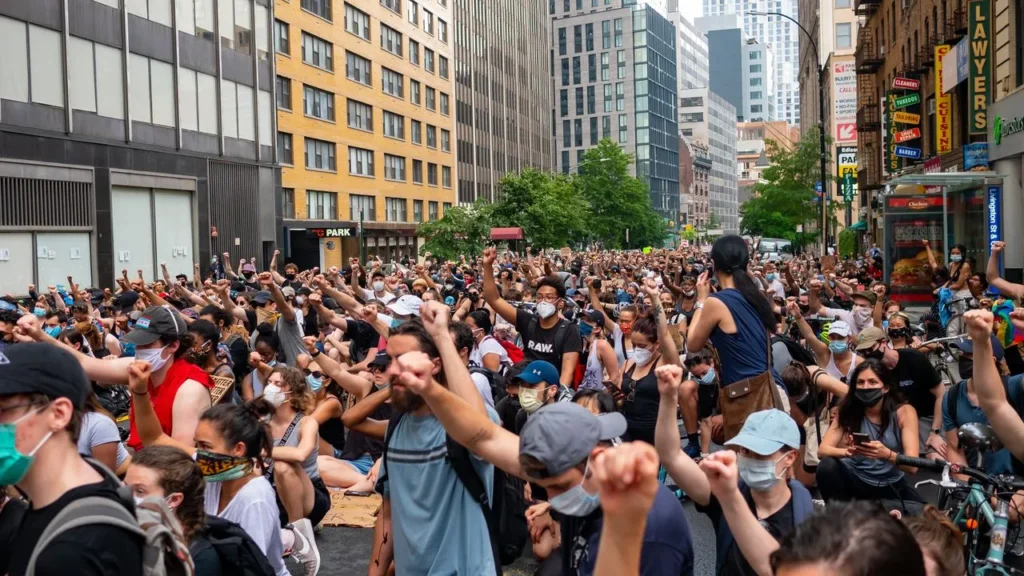
One of the most important figures in the Love Canal story was a local resident named Lois Gibbs.
She was not a scientist.
She was not a politician.
She was a mother.
When concerns arose about possible health risks near the local school attended by her son, Gibbs began searching for answers.
What she discovered alarmed her.
As she spoke with neighbors, a troubling pattern emerged.
Many families reported health problems.
Pregnancy complications.
Birth defects.
Chronic illnesses.
Residents increasingly suspected that the buried chemicals were affecting their community.
Gibbs organized neighbors, collected information, and pushed officials to investigate.
Her efforts transformed a local concern into a national story.
Without her persistence, Love Canal might never have gained widespread attention.
The Investigation
As public pressure increased, scientists and government agencies began examining conditions in the neighborhood.
The findings were disturbing.
Investigators discovered that chemical waste was escaping from the old disposal site.
Contamination had spread into surrounding areas.
Groundwater, soil, and residential properties showed signs of chemical exposure.
The situation was no longer viewed as an isolated concern.
It had become a major environmental crisis.
The more investigators uncovered, the more difficult it became to dismiss residents’ fears.
National Attention and Public Outrage
Media coverage soon brought national attention to Love Canal.
Television crews arrived.
Newspapers covered the story extensively.
Images of contaminated homes and frightened residents appeared across the country.
For many Americans, Love Canal became a shocking example of what could happen when industrial waste was poorly managed.
The story raised uncomfortable questions.
How could homes and schools have been built near a toxic waste site?
Why had warnings not come sooner?
Who was responsible?
Public trust in both corporations and government agencies began to erode.
Evacuations and Relocations
As evidence mounted, government officials faced increasing pressure to act.
Eventually, emergency measures were announced.
Many families were relocated from the area.
Homes were purchased by the government.
Entire sections of the neighborhood were abandoned.
For residents, leaving was often emotionally devastating.
Many had invested their life savings into their homes.
Others had spent years building relationships and raising families in the community.
Now they were being forced to leave behind the lives they had created.
The physical contamination was only part of the damage.
The emotional and financial consequences would last for years.
The Birth of a New Environmental Era
Love Canal changed more than one neighborhood.
It changed how the United States approached hazardous waste.
The disaster helped inspire the creation of the Comprehensive Environmental Response, Compensation, and Liability Act of 1980—commonly known as the Superfund program.
The legislation gave the federal government greater authority to identify and clean up dangerous contaminated sites.
Love Canal became a symbol.
A warning about the consequences of ignoring environmental risks.
And a reminder that hidden hazards can remain buried for decades before revealing their true cost.
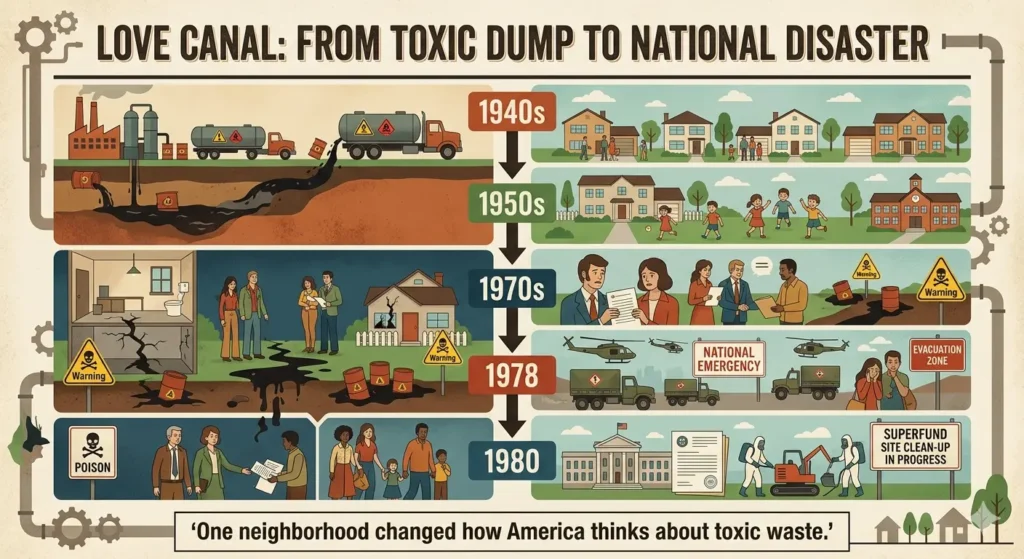
The Legacy of Love Canal Reaches Beyond One Neighborhood
Love Canal was not the first public health disaster, nor would it be the last. Similar patterns appear throughout history whenever warning signs are ignored, risks are underestimated, or powerful interests delay action.
The Leaded Gasoline Scandal: How One Invention Poisoned the World — how a fuel additive spread toxic lead pollution across entire populations.
How Asbestos Became One of History’s Biggest Public Health Disasters — how a trusted industrial material exposed millions to serious health risks.
The Tobacco Industry Cover-Up: How Cigarettes Stayed “Safe” for Decades — another example of scientific warnings colliding with powerful commercial interests.
Lessons From Love Canal
Love Canal reminds us that environmental disasters are not always sudden.
Sometimes they develop Waste
A decision made decades earlier can affect people who had no role in making it.
The families who moved into Love Canal did not create the problem.
Many had no idea it existed.
Yet they lived with the consequences.
The disaster also demonstrates the importance of transparency, accountability, and independent investigation.
Without residents demanding answers, the contamination may have remained hidden much longer.
Final Thoughts
At first glance, Love Canal looked like an ordinary American neighborhood.
Families lived there.
Children played there.
People planned their futures there.
But beneath the streets and homes lay a toxic legacy that would eventually transform the community into a symbol of environmental failure.
Today, Love Canal remains one of the most important cautionary tales in modern history.
Not because it was the only environmental disaster.
But because it revealed how easily dangerous problems can remain hidden until ordinary people begin asking the right questions.
And by the time those answers arrive, the damage may already be done.
Sources & Further Reading
- U.S. Environmental Protection Agency (EPA) — Love Canal Site Profile
- New York State Department of Health — Love Canal Public Health Information
- National Institute of Environmental Health Sciences (NIEHS) — Hazardous Waste and Public Health
- Library of Congress — Love Canal and the Environmental Movement