
Imagine Discovering Your Drinking Water Contains Chemicals That May Never Truly Disappear
You pour yourself a glass of water.
It looks perfectly clean.
It has no unusual smell, no strange taste, and nothing to suggest that anything is wrong.
Then you learn that scientists have detected a group of synthetic chemicals in your local water supply—chemicals designed to resist heat, grease, stains, and even nature itself.
Unlike most pollutants, they don’t easily break down.
They can remain in soil for decades, travel through rivers and groundwater, accumulate in wildlife, and linger inside the human body for years.
Today, these substances are commonly known as forever chemicals. PFAS is a huge family of thousands of chemicals, with estimates exceeding 10,000 depending on the definition used.
Scientists call them PFAS, short for per- and polyfluoroalkyl substances—a large family of thousands of human-made chemicals first developed during the twentieth century.
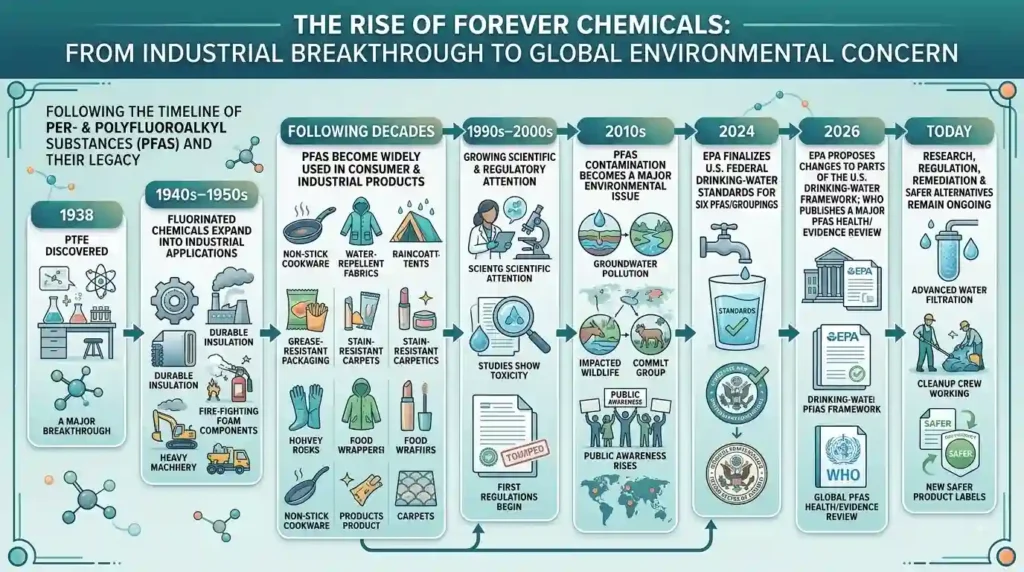
For decades, PFAS were celebrated as a technological breakthrough. They helped create non-stick cookware, waterproof clothing, stain-resistant fabrics, food packaging, firefighting foam, and countless industrial products that transformed everyday life.
Few people questioned their success.
Fewer still imagined that the same chemical properties making PFAS so useful would eventually become one of their greatest environmental challenges.
Today, governments, scientists, manufacturers, and communities around the world are grappling with a question that didn’t seem urgent eighty years ago:
What happens when a chemical designed to last almost forever is released into the environment?
The answer has reshaped environmental science, influenced public health research, triggered major legal battles, and prompted countries around the world to rethink how these chemicals should be regulated.
This is the story of how one of modern industry’s greatest innovations quietly became one of the world’s biggest environmental concerns.
From Laboratory Discovery to Global Innovation
The story of PFAS began long before the phrase “forever chemicals” existed.
In 1938, chemist Roy Plunkett, working for DuPont, accidentally discovered polytetrafluoroethylene (PTFE), a fluoropolymer, while experimenting with refrigerant gases. The material proved remarkably different from anything scientists had seen before.
It was extraordinarily resistant to heat.
It repelled water.
It resisted grease, acids, and many corrosive chemicals.
Perhaps most importantly for manufacturers, it remained stable under conditions that caused many other materials to fail.
The discovery would later become widely known under the brand name Teflon, but it also demonstrated the remarkable properties of fluorinated chemistry that would lead to the development of thousands of related PFAS compounds over the following decades.
During the 1940s and 1950s, industries rapidly embraced these materials.
Engineers found they could improve industrial machinery.
Manufacturers discovered they could produce cookware that food wouldn’t stick to.
Textile companies created fabrics that resisted stains and water.
Food packaging became more resistant to grease.
Firefighting organizations adopted specialized PFAS-based foams capable of suppressing high-intensity fuel fires.
What began as a scientific discovery soon became an industrial revolution.
By the late twentieth century, PFAS had become part of thousands of products used every day by millions of people—often without anyone realizing these chemicals were present at all.
Unlike asbestos or lead, PFAS were never viewed as dangerous during their early decades of widespread use.
They represented progress.
Innovation.
Convenience.
And like many technological breakthroughs throughout history, the full consequences of their success would only become apparent much later.
Why Scientists Call Them “Forever Chemicals”
Most chemicals released into the environment eventually break down.
Sunlight, water, bacteria, and natural chemical reactions gradually reduce them into simpler compounds. Some disappear within days, others take years.
PFAS behave very differently.
Their defining feature is an exceptionally strong carbon-fluorine bond—one of the strongest chemical bonds found in organic chemistry. This bond makes many PFAS compounds remarkably resistant to heat, water, oil, and natural degradation.
In practical terms, that means certain PFAS can remain in the environment for years, decades, or even longer under some conditions.
They don’t simply disappear after a product is thrown away.
Instead, they can move through soil, seep into groundwater, travel through rivers, accumulate in sediments, and enter food chains. Some PFAS compounds can also remain in the human body for years before being eliminated.
This unusual persistence is what earned them the nickname “forever chemicals.”
It is important to remember that PFAS are not a single chemical.
Scientists have identified thousands of different PFAS compounds, each with different properties, uses, and environmental behavior. Some have been studied extensively, while many others remain under active scientific investigation.
That complexity is one reason regulating PFAS has become such a significant challenge around the world.
Why Scientists Call Them “Forever Chemicals”
Most chemicals released into the environment eventually break down.
Sunlight, water, bacteria, and natural chemical reactions gradually reduce them into simpler compounds. Some disappear within days, others take years.
PFAS behave very differently.
Their defining feature is an exceptionally strong carbon-fluorine bond—one of the strongest chemical bonds found in organic chemistry. This bond makes many PFAS compounds remarkably resistant to heat, water, oil, and natural degradation.
In practical terms, that means certain PFAS can remain in the environment for years, decades, or even longer under some conditions.
They don’t simply disappear after a product is thrown away.
Instead, they can move through soil, seep into groundwater, travel through rivers, accumulate in sediments, and enter food chains. Some PFAS compounds can also remain in the human body for years before being eliminated.
This unusual persistence is what earned them the nickname “forever chemicals.”
It is important to remember that PFAS are not a single chemical.
Scientists have identified thousands of different PFAS compounds, each with different properties, uses, and environmental behavior. Some have been studied extensively, while many others remain under active scientific investigation.
That complexity is one reason regulating PFAS has become such a significant challenge around the world.
From Kitchen Cabinets to Airports: How PFAS Became Part of Everyday Life
Unlike many industrial chemicals used only inside factories, PFAS quietly became part of everyday life.
Their unique properties made them attractive across dozens of industries.
Manufacturers used them to produce cookware that resisted sticking.
Clothing companies developed jackets and outdoor gear that repelled rain.
Furniture manufacturers created stain-resistant fabrics.
Food packaging became more resistant to grease.
Firefighters relied on specialized firefighting foams capable of suppressing fuel fires at airports, military bases, and industrial facilities.
PFAS were also used in certain cosmetics, electronics manufacturing, medical equipment, automotive components, and numerous industrial processes.
By the late twentieth century, these chemicals had become deeply woven into modern manufacturing.
Ironically, most consumers had never heard of PFAS.
People bought waterproof jackets without knowing what made them waterproof.
They cooked with non-stick pans without wondering why food slid effortlessly across the surface.
Convenience became so ordinary that few people questioned the chemistry behind it.
That widespread adoption would later become one of the biggest obstacles to addressing PFAS contamination.
The chemicals weren’t concentrated in one factory or one industry.
They were nearly everywhere.
How Did Nobody Notice for So Long?
One of the most common questions people ask today is surprisingly simple:
If PFAS are so persistent, why weren’t they discovered decades earlier?
The answer is more complicated than many people expect.
First, PFAS contamination often developed slowly.
Unlike an oil spill or a chemical explosion, PFAS generally entered the environment gradually through manufacturing, wastewater, industrial disposal, and firefighting activities.
There was no single dramatic event that immediately captured public attention.
Second, scientists simply didn’t have today’s analytical technology.
Modern laboratory equipment can detect PFAS at incredibly low concentrations—levels that were impossible to measure accurately several decades ago.
As testing methods improved, researchers began finding PFAS in places they had never looked before.
Drinking water.
Rivers.
Fish.
Wildlife.
Agricultural land.
Eventually, even human blood samples.
These discoveries transformed what had once been considered a niche environmental issue into a global scientific concern.
At the same time, researchers continued studying how different PFAS compounds move through the environment and how long they remain in living organisms.
Many important questions are still being investigated today, which is why scientific understanding continues to evolve.
Why Are Forever Chemicals Suddenly Everywhere?
PFAS aren’t new.
The attention surrounding them is.
Several developments have pushed the chemicals into public view at the same time.
Better analytical techniques have made it possible to detect extremely small concentrations.
Environmental monitoring has uncovered contamination in communities near industrial facilities, military sites, airports and other locations associated with PFAS use.
Researchers have accumulated decades of evidence about the persistence and behavior of certain PFAS.
Governments have begun establishing or considering drinking-water standards.
And lawsuits involving major chemical manufacturers have brought the issue into the public spotlight.
The result is an unusual situation: a decades-old chemical problem becoming a modern political, scientific and consumer issue all at once.
And the science is still moving.
In July 2026, WHO published its new PFAS landscape review, while the U.S. EPA was simultaneously revising aspects of its federal drinking-water approach.
So if it feels like “forever chemicals” suddenly appeared everywhere, they didn’t.
The public conversation caught up with the chemicals.
The Science Is Still Moving
Even the world’s major health organizations have not finished answering every question about PFAS.
In July 2026, the World Health Organization published a landscape review examining PFAS occurrence and potential health effects. The review identified 77 PFAS from occurrence evidence and 66 PFAS from health-effects evidence, helping WHO prioritize chemicals and health-effect categories for more detailed evaluation.
WHO has now prioritized 18 PFAS and six health-outcome categories for further systematic review, including cardiometabolic, liver, immune, developmental, reproductive, and cancer-related outcomes. WHO says the work is intended to support future health-based values for PFAS in food and drinking water.
That matters because “PFAS” is not one chemical with one risk profile.
It is a huge family of substances.
Scientists are increasingly trying to understand them individually, as groups, and as mixtures.
The result is a scientific picture that is becoming clearer—but is still developing.
What Do Scientists Know About Health Effects?
PFAS research has become extensive, but the evidence needs to be handled carefully.
Different PFAS can behave differently, and scientists have not studied every compound equally.
For some of the better-studied PFAS, research has found associations with particular health outcomes. The U.S. Agency for Toxic Substances and Disease Registry (ATSDR) currently identifies associations involving increased cholesterol, lower antibody responses to some vaccines, changes in liver enzymes, pregnancy-induced hypertension and preeclampsia, small decreases in birth weight, and kidney and testicular cancer in relation to specific PFAS such as PFOA.
That does not mean that exposure to PFAS automatically causes these conditions.
Risk depends on factors including the specific chemical, dose, duration and route of exposure, as well as individual characteristics.
Scientists are also still studying mixtures of PFAS, which makes the issue even more complicated.
In July 2026, ATSDR updated its clinical information for healthcare providers, noting that the mechanisms behind several potential health effects remain an active area of research.
That uncertainty is important.
The story is serious enough to warrant regulation and exposure reduction, but it should not be turned into a list of guaranteed health outcomes.
Why Cleaning Up PFAS Is So Difficult
Cleaning up many environmental pollutants is challenging.
Cleaning up PFAS can be even more difficult.
Once certain PFAS compounds enter groundwater or soil, removing them completely may require specialized treatment technologies.
Traditional water treatment methods are often insufficient for many PFAS compounds.
Advanced filtration systems, including activated carbon and reverse osmosis, can reduce PFAS concentrations in drinking water, but they do not eliminate the broader environmental problem.
Scientists are also exploring new technologies capable of destroying PFAS rather than simply capturing them.
Although promising research continues, large-scale cleanup remains technically complex and expensive.
For many experts, preventing new contamination is currently more effective than attempting to remove decades of existing pollution.
Governments Are Finally Catching Up
As scientists learned more about PFAS, governments began moving from monitoring and research toward regulation.
But the response has not been uniform.
In the United States, the Environmental Protection Agency finalized the country’s first nationwide legally enforceable drinking-water standards for PFAS in April 2024. The rule established a 4.0-parts-per-trillion maximum contaminant level for PFOA and PFOS, along with limits for PFHxS, PFNA, HFPO-DA (GenX chemicals), and certain mixtures.
The rules are now entering a more complicated phase.
On May 18, 2026, EPA proposed keeping the federal PFOA and PFOS limits while allowing qualifying water systems to request an additional two years—potentially moving their compliance deadline to 2031. At the same time, EPA proposed rescinding the federal drinking-water requirements for PFHxS, PFNA, HFPO-DA and the associated Hazard Index mixture. As of August 2026, these changes remain proposals rather than a completed replacement of the existing regulation.
That makes the current PFAS story more complicated than simply saying governments are “tightening regulations.”
They are.
But they are also debating which chemicals should be regulated, at what levels, and how quickly water systems should be required to comply.
The debate is far from over.
Can Forever Chemicals Be Removed?
The answer depends on what “removed” means.
PFAS can be reduced from contaminated drinking water using treatment technologies such as activated carbon, ion exchange and reverse osmosis. EPA’s regulatory materials identify several treatment approaches capable of removing PFOA and PFOS from drinking water.
But removing PFAS from one water supply is very different from eliminating PFAS from the environment.
Contaminated groundwater and soil can remain affected long after the original source of pollution has stopped.
Some treatment systems also capture PFAS rather than destroy them. The chemicals then have to be managed in another concentrated waste stream.
Scientists are therefore working on technologies that could actually break down PFAS rather than simply move them from one place to another.
That remains an active area of research.
The simplest environmental solution is still the least dramatic one:
prevent new contamination from occurring in the first place.
More Questions Than Answers
One reason the PFAS conversation continues to evolve is because scientists are still learning.
Although certain PFAS compounds have been studied for decades, thousands of others remain poorly understood.
Researchers continue asking questions such as:
- How do different PFAS compounds behave in the environment?
- Why do some remain in the human body longer than others?
- Which replacement chemicals are genuinely safer?
- How can contaminated ecosystems be restored more effectively?
- What technologies can permanently destroy PFAS?
These questions demonstrate why the story of forever chemicals is still unfolding.
Why This Matters to Everyone
One reason forever chemicals have attracted worldwide attention is that they challenge a long-held assumption about technological progress.
Modern society often celebrates innovation for solving immediate problems.
PFAS certainly did.
They made products safer, stronger, more durable, and more convenient.
Waterproof jackets kept people dry.
Non-stick cookware transformed kitchens.
Specialized firefighting foams helped control dangerous fuel fires.
These innovations delivered genuine benefits.
Yet the same characteristics that made PFAS valuable also created unexpected environmental challenges that only became fully visible decades later.
This doesn’t mean innovation is inherently harmful.
It reminds us that understanding the long-term consequences of new technologies often takes far longer than developing the technologies themselves.
This Story Is Only Beginning
Although this article explains how forever chemicals became a global environmental concern, it only scratches the surface.
In the coming articles, we’ll explore questions many readers are asking today, including:
- Can Your Body Get Rid of Forever Chemicals?
- Forever Chemicals in Drinking Water: Why Millions Are Concerned
- PFAS in Non-Stick Cookware: Should You Be Worried?
- Forever Chemicals in Food Packaging Explained
- PFAS Lawsuits: Why Major Chemical Companies Are Facing Legal Challenges
- Why Are Clothing Brands Being Linked to Forever Chemicals?
- How Scientists Are Trying to Destroy Forever Chemicals
Each article will examine one aspect of the PFAS story in greater depth, separating established scientific evidence from common misconceptions.
Conclusion
For decades, PFAS quietly became part of modern life.
They helped engineers solve problems, manufacturers build better products, and consumers enjoy conveniences that quickly became ordinary.
Few people questioned the chemistry behind those innovations.
Today, forever chemicals represent one of the world’s most closely studied environmental challenges.
Not because they appeared overnight.
But because decades of scientific research gradually revealed how remarkably persistent they truly are.
The story of PFAS is still being written.
Scientists continue searching for better answers.
Governments continue refining regulations.
Manufacturers continue developing alternatives.
Communities continue testing their water.
And researchers continue exploring one of the most difficult questions modern environmental science has ever faced:
What happens when the chemicals that improved everyday life refuse to disappear?
Perhaps the most important lesson isn’t about chemistry at all.
It’s about curiosity.
History repeatedly shows that today’s breakthrough can become tomorrow’s challenge—not because innovation is a mistake, but because understanding its full consequences often takes generations.
The story of forever chemicals reminds us that the greatest technological advances deserve not only celebration, but also continuous scientific scrutiny.
Related Posts
[Minamata Disease: The Mercury Poisoning Disaster That Changed Environmental History] — how industrial mercury pollution contaminated a Japanese community and transformed the way environmental poisoning was understood.
[Love Canal: The Neighborhood Built on Toxic Waste] — how buried chemical waste turned an ordinary residential neighborhood into one of America’s most infamous environmental disasters.
[The Leaded Gasoline Scandal: How One Invention Poisoned the World] — how a widely adopted fuel additive exposed populations to lead contamination for decades before its dangers became impossible to ignore.
[How Asbestos Became One of History’s Biggest Public Health Disasters] — how a material once celebrated for its versatility became associated with widespread occupational and environmental health risks.
Sources & Further Reading
U.S. EPA — PFAS and Drinking Water
WHO — PFAS and Human Health Landscape Review, July 2026
ATSDR/CDC — PFAS and Your Health
OECD — PFAS Chemicals and Their Uses
ECHA— PFAS Restriction Page




What an informational article.
I like this article