
Imagine landing what seemed like the perfect factory job.
The pay was steady. The work was respected. And the product you helped create represented the cutting edge of modern technology.
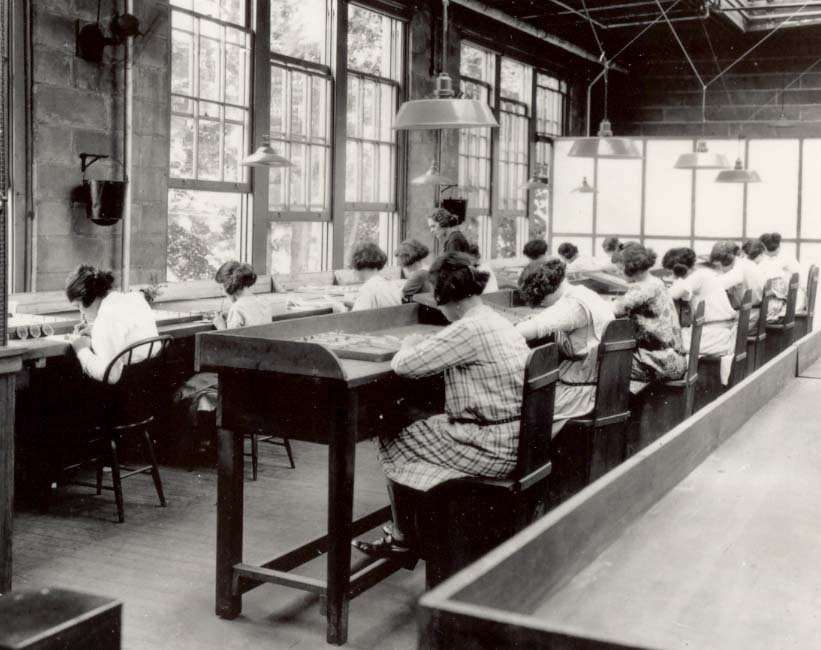
Each day, young women sat at long workbenches carefully painting watch and clock dials with a glowing substance that fascinated the world.
Supervisors even encouraged them to shape the tips of their paintbrushes with their lips to produce finer lines.
“Lip, dip, paint.”
Hundreds of times a day.
No one warned them that the glowing paint contained radium—a radioactive element that was slowly entering their bodies with every brushstroke.
Years later, unexplained illnesses began appearing.
Healthy young women started losing teeth.
Their jaws deteriorated.
Bones fractured without warning.
Doctors struggled to explain what was happening.
What began as an ordinary factory job would become one of the most important workplace safety scandals in modern history.
History remembers them as the Radium Girls.
A World Fascinated by Radium
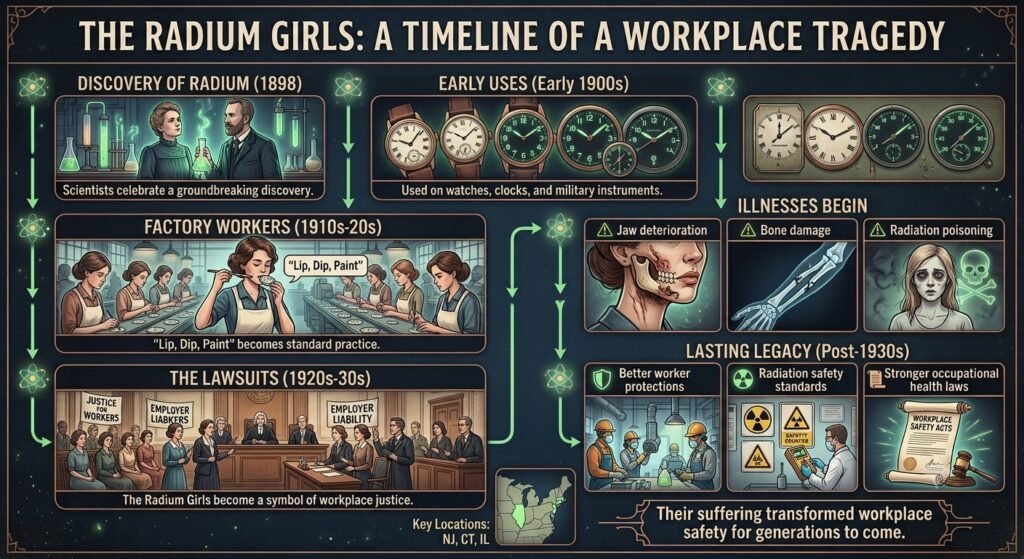
When scientists discovered radium in 1898, it was celebrated as a scientific miracle.
Its mysterious glow captured the public’s imagination.
Many believed radium represented the future.
Manufacturers quickly began adding it to all kinds of products.
Toothpaste.
Cosmetics.
Medicines.
Health tonics.
Even drinking water marketed as beneficial sometimes contained radioactive substances.
Although scientists were still learning about radiation, public enthusiasm often outweighed caution.
Few people fully understood the long-term dangers.
The Job Everyone Wanted
During the early twentieth century, factories across the United States hired young women to paint watch and instrument dials with luminous radium paint.
The work required patience and precision.
To create sharp brush tips, workers were instructed to place the brushes between their lips before dipping them back into the paint.
The process became second nature.
Lip.
Dip.
Paint.
Repeat.
Some women repeated the motion hundreds of times during a single shift.
Each repetition introduced tiny amounts of radium into their bodies.
No one told them the practice could be dangerous.
Many were even reassured that the material was safe.
When the Illnesses Began
The first symptoms appeared gradually.
At first, workers complained of toothaches.
Dentists removed teeth that refused to heal.
Instead of recovering, some women developed severe infections.
Their jawbones began deteriorating.
In several cases, sections of bone simply broke away.
Doctors struggled to understand the mysterious illness.
As time passed, additional problems emerged.
Bone fractures.
Chronic pain.
Anemia.
Fatigue.
Some women became too weak to work.
Others died while still in their twenties.
The connection between their illnesses and radium exposure slowly became impossible to ignore.
The Companies’ Response
Rather than immediately acknowledging the dangers, some employers questioned the workers’ claims.
Responsibility was disputed.
Scientific uncertainty was emphasized.
Some illnesses were attributed to unrelated causes.
For the affected women, this added another burden.
They were not only fighting a devastating illness.
They also had to fight to be believed.
As more evidence emerged, independent researchers began reaching different conclusions.
Radium was behaving inside the body much like calcium.
It accumulated in bones.
Over time, the radiation damaged surrounding tissue from within.
The danger had never been the glowing paint alone.
It was the invisible radioactive exposure that continued long after each workday ended.
The Fight for Justice
Several of the affected workers refused to remain silent.
Despite declining health, they pursued legal action against their employers.
The lawsuits were difficult.
Many companies possessed greater financial resources.
Some workers were already terminally ill before their cases reached court.
Yet their determination drew national attention.
Newspapers reported the story.
Public sympathy grew.
The legal battles helped expose serious shortcomings in workplace safety and employer accountability.
Although many of the women never lived long enough to fully enjoy the outcome, their courage reshaped conversations about occupational health.
How the Radium Girls Changed Workplace Safety
The impact of their case extended far beyond one factory.
Their experiences contributed to stronger workplace protections.
Employers became subject to greater scrutiny regarding employee safety.
Scientific research into radiation exposure accelerated.
Occupational diseases received increased legal recognition.
Modern workplace safety standards did not emerge overnight.
They were built, in part, because workers like the Radium Girls forced society to confront uncomfortable truths.
Their suffering became a catalyst for change.
Why Their Story Still Matters
The Radium Girls are remembered not only because of what happened to them, but because their story continues to feel relevant.
New technologies often arrive with excitement.
Economic incentives encourage rapid adoption.
Safety research sometimes struggles to keep pace.
History reminds us that innovation alone is not enough.
Progress also requires transparency, accountability, and the willingness to respond when warning signs appear.
When Progress Comes Without Protection
The Radium Girls were not the first people harmed by overlooked risks, and they would not be the last.
History repeatedly shows what can happen when enthusiasm for innovation outpaces concern for long-term safety.
Readers interested in similar stories may also enjoy:
How Asbestos Became One of History’s Biggest Public Health Disasters — how a widely trusted building material exposed millions to serious health risks.
The Leaded Gasoline Scandal: How One Invention Poisoned the World — how a fuel additive contaminated cities for decades before meaningful action was taken.
Love Canal: The Neighborhood Built on Toxic Waste — how buried chemical waste transformed an ordinary neighborhood into one of America’s most infamous environmental disasters.
The Tobacco Industry Cover-Up: How Cigarettes Stayed “Safe” for Decades — another example of scientific warnings colliding with powerful commercial interests.
Final Thoughts
The Radium Girls never set out to change history.
They simply wanted stable jobs during a time when opportunities for women were limited.
Instead, they became symbols of a much larger struggle.
Their courage helped expose the hidden dangers of radium, challenged powerful employers, and transformed workplace safety for future generations.
Today, their story serves as a reminder that some of history’s greatest changes begin with ordinary people refusing to accept extraordinary injustice.