
The asbestos public health disaster did not happen overnight. For much of the twentieth century, asbestos was considered one of the most useful materials on Earth.
It was strong, inexpensive, resistant to heat, and seemingly perfect for modern construction.
Homes used it for insulation.
Factories relied on it for safety.
Ships, schools, hospitals, and office buildings were built with it.
At its peak, asbestos was woven into everyday life so completely that few people questioned its presence.
To many, it represented progress.
A material that could make buildings safer, industries more efficient, and products more durable.
But beneath that reputation was a growing problem.
As asbestos use expanded across the world, evidence began emerging that the same fibers making the material so useful could also be incredibly dangerous when inhaled.
What followed was not a single mistake or sudden discovery.
It was a decades-long public health disaster involving scientific warnings, industrial dependence, delayed action, and millions of people unknowingly exposed to a substance that would later be linked to severe and often fatal diseases.
Today, asbestos is remembered not as a miracle material, but as one of the most infamous public health failures in modern history.
Understanding how that happened reveals a story far larger than asbestos itself.
What Is Asbestos?
Asbestos is a group of naturally occurring minerals made up of tiny fibers.
These fibers are:
- heat resistant
- chemically resistant
- strong and durable
- inexpensive to produce
To manufacturers, it seemed perfect.
By the early 20th century, asbestos was being used in:
- insulation
- roofing materials
- floor tiles
- cement products
- brake pads
- shipbuilding
- industrial equipment
The material became so common that millions of people encountered it daily without giving it a second thought.
What they didn’t know was that microscopic asbestos fibers could become trapped inside the body for decades.
The First Warnings Appeared Earlier Than Most People Realize
Many people assume asbestos dangers were only discovered recently.
That isn’t true.
Medical concerns began appearing more than a century ago.
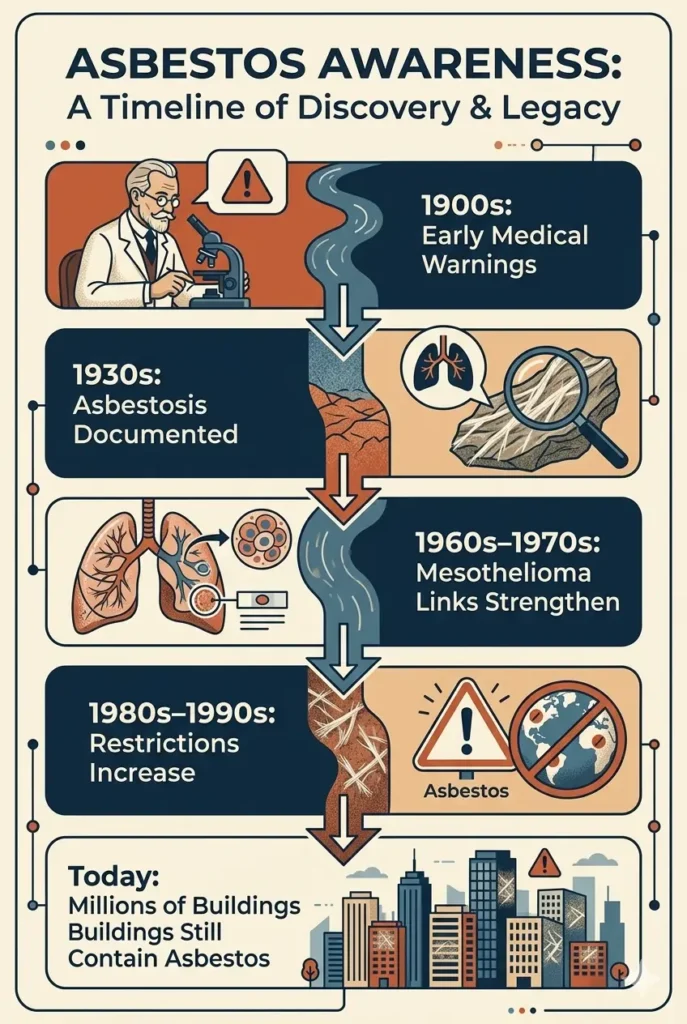
By the early 1900s, doctors had started noticing unusual lung problems among asbestos workers.
Workers exposed to large amounts of asbestos dust often developed severe respiratory illnesses.
By the 1920s and 1930s, researchers were documenting a condition that would later become known as asbestosis — a chronic lung disease caused by inhaling asbestos fibers.
The warnings were there.
The problem was what happened next.
When the Warnings Became Impossible to Ignore
Perhaps the most disturbing part of the asbestos story isn’t that the dangers existed.
It’s that evidence suggests many companies knew far more than the public.
Internal documents uncovered through lawsuits and investigations later revealed that some manufacturers had been aware of serious health concerns for decades.
Researchers continued linking asbestos exposure to severe diseases.
Workers continued getting sick.
Medical evidence continued growing.
Yet asbestos remained highly profitable.
And when profit collides with public health, history shows that uncomfortable information is often delayed, disputed, or ignored.
The asbestos industry was not the first to follow this pattern.
Readers interested in similar corporate deception may also want to explore The Tobacco Industry Cover-Up: How Cigarettes Stayed “Safe” for Decades.
The Disease That Changed Everything
One disease would eventually become impossible to ignore.
Mesothelioma.
Mesothelioma is a rare and aggressive cancer strongly associated with asbestos exposure.
What made it particularly alarming was its long latency period.
People could be exposed to asbestos in their twenties and not develop symptoms until their fifties, sixties, or even later.
This created a dangerous illusion.
For years, everything appeared normal.
Then decades later, serious illness emerged.
By the time symptoms appeared, treatment options were often limited.
Researchers increasingly connected mesothelioma cases to asbestos exposure.
The evidence became harder to dismiss.
Why Asbestos Remained Widely Used for Decades
The asbestos story raises an uncomfortable question:
If the risks were becoming clear, why did asbestos remain so widespread?
Several factors played a role.
1. Economic Incentives
Asbestos was enormously profitable.
Entire industries relied on it.
Replacing it would have been expensive.
2. Scientific Uncertainty
Companies often pointed to gaps in research.
Even when evidence was growing, uncertainty became a reason to delay action.
3. Public Awareness Was Limited
Most people had never heard of mesothelioma.
Many workers had no idea they were being exposed.
Without widespread awareness, pressure for change remained limited.
4. Long Disease Latency
The effects could take decades to appear.
That delay made it easier to downplay the connection between exposure and illness.
Together, these factors created the perfect conditions for a prolonged public health disaster.
The Human Cost
Statistics help tell the story.
But the real impact was personal.
Construction workers.
Factory workers.
Shipyard employees.
Electricians.
Mechanics.
Teachers.
Families.
Some people were exposed directly through their jobs.
Others encountered asbestos in older buildings or through contaminated work clothing brought home by family members.
Many had no idea they were at risk.
The consequences often appeared years later.
A persistent cough.
Breathing difficulties.
A devastating diagnosis.
For countless families, the warning arrived far too late.
Why Asbestos Is Still A Problem Today
Many people assume asbestos disappeared long ago.
In reality, the story isn’t over.
Although asbestos use has declined significantly in many countries, older buildings still contain asbestos-containing materials.
Schools.
Factories.
Homes.
Commercial properties.
In many cases, these materials remain relatively safe if left undisturbed.
The danger increases when asbestos fibers become airborne during renovations, demolition, or damage.
That is why asbestos removal remains heavily regulated in many places.
Even today, exposure continues to be a public health concern.
The legacy of asbestos is still unfolding decades after the first warnings appeared.
A Familiar Pattern in History
The asbestos scandal is not just about one material.
It reflects a broader pattern seen throughout history.
A profitable product emerges.
Early warnings appear.
Industry challenges the evidence.
Public awareness lags behind.
The consequences arrive years later.
By the late twentieth century, evidence linking asbestos exposure to serious disease had become overwhelming. Governments began introducing restrictions, lawsuits multiplied, and public awareness grew. But for many families, these changes arrived long after the damage had already been done.
Similar patterns have appeared in:
- tobacco
- leaded gasoline
- certain chemical contaminants
- environmental disasters
The details differ.
The pattern often remains surprisingly similar.
Lessons From the Asbestos Disaster
The asbestos story reminds us that technological progress and public safety do not always move together.
A product can be useful and dangerous at the same time.
A material can be profitable and harmful.
And scientific warnings can be ignored when powerful interests are involved.
History is filled with examples where the evidence existed long before action followed.
The tragedy is that many of those consequences were preventable.
Final Thoughts
For much of the twentieth century, asbestos was treated as a miracle material.
In reality, it became one of the most infamous industrial health disasters in modern history.
The danger was not hidden because nobody knew.
The danger remained hidden because warnings failed to reach the people who needed them most.
Today, asbestos serves as a reminder that skepticism is sometimes necessary when industries insist a product is completely safe despite growing evidence to the contrary.
And perhaps the most unsettling lesson of all is this:
The asbestos story wasn’t a unique failure.
It was part of a pattern that has repeated itself throughout history.
You may also want to explore:
The Tobacco Industry Cover-Up: How Cigarettes Stayed “Safe” for Decades — another case where scientific warnings collided with corporate interests.
Sources & Further Reading
World Health Organization (WHO) — Asbestos: Elimination of Asbestos-Related Diseases
International Agency for Research on Cancer (IARC) — Asbestos and Cancer Classification
American Cancer Society — Asbestos and Cancer Risk