
Most people assume leaving a harmful relationship should feel obvious.
If someone constantly hurts you, manipulates you, leaves you anxious, or drains your confidence, walking away should feel like the logical decision.
So why do so many people stay?
Why does silence suddenly feel unbearable after finally leaving?
Why do people miss someone who repeatedly made them cry?
This is where trauma bonding becomes deeply confusing.
Because trauma bonds rarely feel toxic all the time.
That is exactly what makes them powerful.
The relationship may swing between emotional distance and closeness. One moment feels painful. The next feels hopeful again.
After an argument, they suddenly become affectionate.
After emotional withdrawal, they seem softer.
After making you question yourself, they offer just enough comfort to make you stay.
And slowly, something strange starts happening:
You stop waiting for consistency and start surviving on moments.
Moments of affection.
Moments of apology.
Moments that make you believe things are finally changing.
That emotional cycle is one reason trauma bonding feels so difficult to break — especially in relationships involving narcissistic behavior, where unpredictability quietly becomes emotional dependency.
The difficult truth?
Leaving is often not just about ending a relationship.
It is about breaking a pattern your mind has learned to emotionally depend on.
And that can feel much harder than most people realize.
If you are still trying to understand whether this pattern describes your relationship, start with 7 Signs You’re Trauma Bonded to a Narcissist (And Don’t Realize It) before continuing. Recognizing the pattern often comes before breaking it.
Why Trauma Bonding Feels So Hard to Break
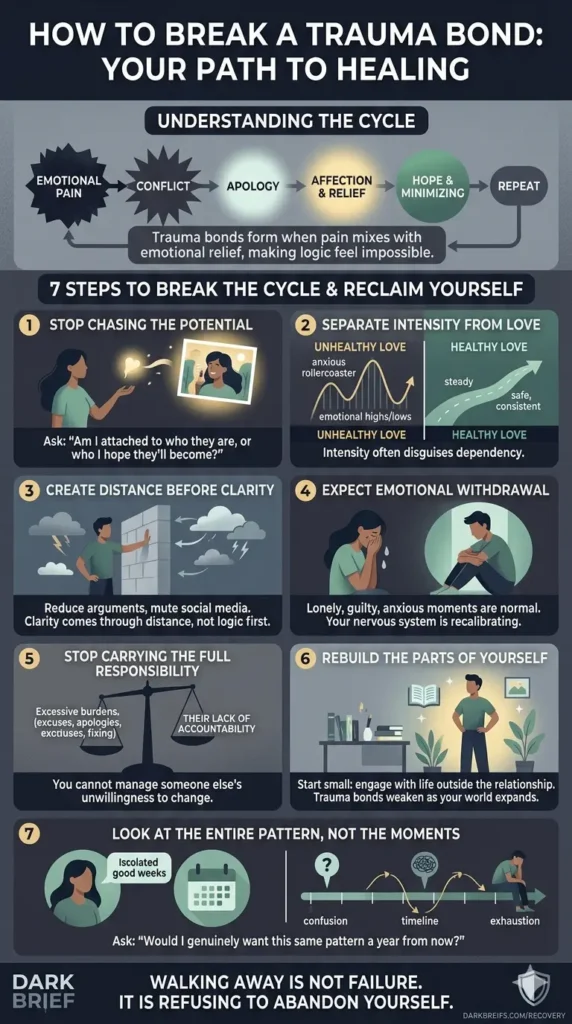
Trauma bonding happens when emotional pain becomes mixed with emotional relief.
In unhealthy relationships, the cycle often looks something like this:
Emotional hurt → conflict → apology → affection → hope → repeat
The painful moments hurt.
But the loving moments feel relieving enough to keep the relationship alive.
And over time, your brain begins attaching to relief rather than stability.
This is why people in trauma bonds often feel trapped between two conflicting truths:
“This relationship is hurting me.”
and
“But I still don’t want to lose them.”
That emotional contradiction is what makes healing feel so complicated.
1. Stop Chasing the Version of Them You Miss
One of the biggest reasons people stay stuck in trauma bonds is surprisingly simple:
They are not attached to the relationship as it is.
They are attached to what it occasionally becomes.
The loving version.
The attentive version.
The version from the beginning.
The problem?
That version may only appear in short emotional bursts.
Enough to restore hope.
Not enough to create consistency.
A helpful question to ask yourself is:
“Am I attached to the person — or the potential?”
Because healthy relationships are built on consistency, not occasional emotional highs.
2. Learn to Separate Emotional Intensity From Love
Trauma bonds rarely feel boring.
If anything, they feel overwhelming.
The highs can feel deeply intimate. The lows can feel devastating. One good weekend suddenly makes you forget weeks of emotional distance. One heartfelt apology briefly makes everything feel repairable again.
That emotional rollercoaster is exactly what makes trauma bonding so confusing.
Because intensity often disguises itself as closeness.
But there is an uncomfortable question worth asking:
If love constantly leaves you anxious, emotionally exhausted, or afraid of the next conflict — what exactly are you holding onto?
Healthy love usually feels steady.
Not perfect.
Not argument-free.
But emotionally safe.
Trauma bonds often feel different. They create cycles of uncertainty that quietly keep people emotionally attached.
You stop feeling secure and start feeling dependent.
And dependence can feel dangerously similar to love when emotions are involved.
3. Create Distance — Even Before You Feel Ready
Most people wait until they feel emotionally strong enough to leave.
The problem?
That moment rarely arrives first.
Distance often comes before clarity, not after it.
And sometimes, even small amounts of emotional distance begin changing how clearly you see the relationship.
That might mean:
- responding less impulsively
- reducing emotional arguments
- muting their social media temporarily
- spending less time emotionally available
This is not about punishment.
It is about reducing emotional reactivation.
Because trauma bonds thrive on emotional interruption.
One emotional message.
One apology.
One moment of vulnerability.
And suddenly, the cycle feels alive again.
Especially if the relationship involved manipulation or emotional confusion.
If you often leave arguments questioning your own reality, you may also recognize patterns discussed in 7 Signs of Narcissistic Gaslighting in a Relationship.
4. Expect Withdrawal — Even If Leaving Was the Right Choice
This is the part few people talk about.
Leaving a trauma bond can feel emotionally brutal at first.
Not because you made the wrong decision.
But because your nervous system became familiar with the cycle.
Sometimes relief arrives slowly.
Before that, many people experience:
- sudden loneliness
- guilt
- anxiety
- urges to reconnect
- obsessive thinking
You may even miss them intensely.
Which feels confusing.
After everything that happened, why would you still want them back?
Because emotional attachment does not disappear the moment logic arrives.
The mind understands before emotions fully catch up.
And during that gap, people often return to relationships they already know are hurting them.
This is where patience matters.
Healing from trauma bonding often feels messy before it feels freeing.

5. Stop Carrying Responsibility That Was Never Fully Yours
One pattern shows up repeatedly in unhealthy relationships:
You slowly become the person trying to hold everything together.
You explain their behavior.
Excuse their actions.
Apologize more.
Try harder.
Communicate better.
Stay calmer.
Meanwhile, the actual problem rarely changes.
At some point, many people in trauma bonds begin treating emotional survival like a full-time responsibility.
But relationships are not supposed to feel like constant emotional damage control.
A difficult question worth sitting with:
Are you trying to fix a relationship — or trying to manage someone else’s unwillingness to change?
That distinction matters.
Especially when accountability only seems to move in one direction.
If this feels familiar, you may also relate to Reactive Abuse — Why Narcissists Make You Look Like the Abuser, where emotional blame quietly shifts onto the person already being hurt.
6. Rebuild the Parts of Yourself That Slowly Disappeared
One of the quietest effects of trauma bonding is how small your world can become.
Sometimes without realizing it, people stop:
- seeing friends regularly
- trusting their instincts
- enjoying hobbies
- feeling emotionally independent
The relationship slowly becomes the center of everything.
Which is exactly why leaving can feel terrifying.
Because it is not only about losing someone.
It can feel like losing routine, identity, hope, and emotional familiarity all at once.
This is why healing works best when it starts small.
Not dramatic reinvention.
Small stability.
Go outside.
Text someone you trust.
Return to something that once made you feel like yourself.
Tiny actions matter more than they seem.
Because trauma bonds weaken when emotional life starts expanding again.
7. Stop Looking at Isolated Moments — Look at the Pattern
One good week can be convincing.
One apology can feel meaningful.
One emotional conversation can temporarily restore hope.
But lasting change is measured in patterns.
Not moments.
Try asking yourself:
If nothing changed, would I genuinely want this same relationship a year from now?
Not the version you hope for.
Not the version you occasionally see.
The actual pattern.
The inconsistency.
The confusion.
The emotional exhaustion.
Sometimes clarity begins when we stop judging relationships by isolated good moments — and start judging them by emotional reality.
Because patterns rarely lie.
Why Breaking a Trauma Bond Feels So Hard
From the outside, people often ask:
“If it hurts so much, why not just leave?”
But trauma bonds are rarely logical.
They are emotional.
Complicated.
Layered.
Hope gets mixed with pain.
Comfort gets mixed with confusion.
And somewhere along the way, leaving starts feeling less like freedom — and more like loss.
But healing usually begins with one uncomfortable realization:
You cannot heal inside the same cycle that keeps hurting you.
If this article felt painfully familiar, it may help to revisit 7 Signs You’re Trauma Bonded to a Narcissist (And Don’t Realize It) to better understand the emotional patterns that make these relationships feel so difficult to leave.
And if there is one thing worth remembering, it is this:
Walking away from something unhealthy does not mean you failed.
Sometimes it simply means you stopped abandoning yourself to keep someone else comfortable.
If this article felt painfully familiar, it may help to revisit
7 Signs You’re Trauma Bonded to a Narcissist (And Don’t Realize It)
7 Signs of Narcissistic Gaslighting in a Relationship
Reactive Abuse — Why Narcissists Make You Look Like the Abuser
For additional information on trauma bonding and emotional abuse patterns:
The National Domestic Violence Hotline — https://www.thehotline.org/
Healthline — https://www.healthline.com/