
Imagine discovering a product that contaminated cities, poisoned children, damaged health, and spread toxic pollution across entire countries.
Now imagine that product remaining in widespread use for decades.
That is the story of leaded gasoline.
For much of the twentieth century, lead was added to fuel around the world. Drivers saw it as a technological breakthrough. Automobile manufacturers praised it. Fuel companies profited from it.
Few people questioned it.
Yet behind the promise of smoother engines was a growing body of evidence suggesting that one of the world’s most successful fuel additives was also one of its most dangerous.
The consequences would take generations to fully understand.
The Problem Engineers Wanted to Solve
In the early days of automobiles, engineers faced a frustrating issue known as engine knocking.
Knocking occurred when fuel ignited unevenly inside an engine, reducing performance and potentially causing damage over time.
Car manufacturers wanted a solution.
A smoother-running engine meant happier customers and more reliable vehicles.
Researchers began testing various additives that could reduce knocking and improve fuel performance.
Eventually, they discovered something that seemed almost perfect.
Tetraethyl lead.
The Discovery That Changed Everything
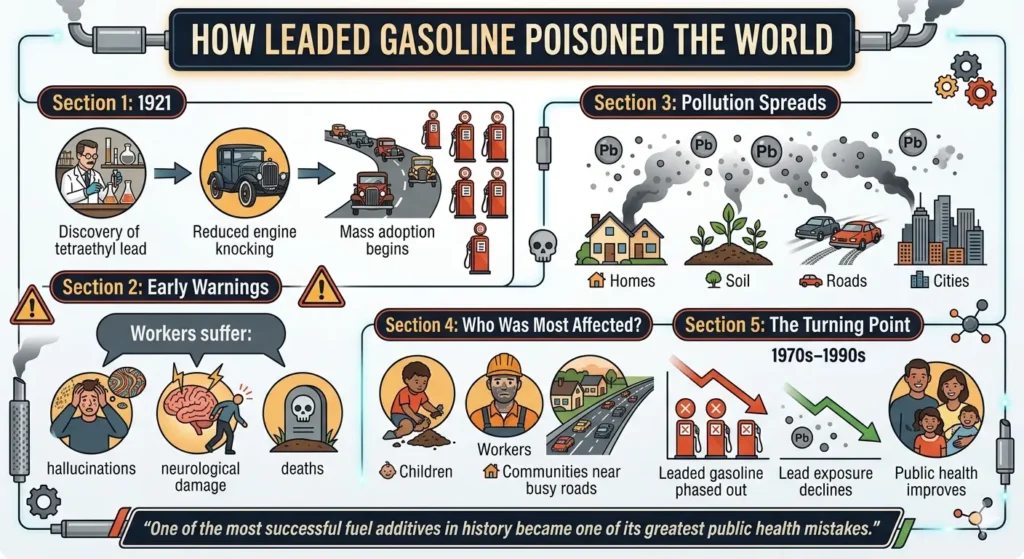
In 1921, researchers working for General Motors found that adding small amounts of tetraethyl lead to gasoline dramatically reduced engine knocking.
The discovery appeared revolutionary.
Cars performed better.
Engines ran more smoothly.
Fuel companies saw enormous commercial potential.
There was only one problem.
Lead was already known to be toxic.
Humanity had understood lead poisoning for centuries.
Ancient civilizations documented its dangers.
Doctors had long observed the harmful effects of prolonged exposure.
Yet despite this history, the new fuel additive was rapidly embraced.
The promise of economic gain proved difficult to resist.
The First Warning Signs Appeared Almost Immediately
The dangers were not hidden for long.
Workers involved in producing tetraethyl lead began experiencing alarming symptoms.
Some suffered hallucinations.
Others developed severe neurological problems.
Several workers died.
At one manufacturing facility, conditions became so disturbing that journalists reportedly referred to it as a “loony gas building.”
Employees behaved erratically.
Some experienced violent mental breakdowns.
Others required hospitalization.
These incidents should have triggered serious concern.
Instead, they were often treated as isolated events rather than warnings of a larger problem.
The product continued moving toward mass adoption.
Why Leaded Gasoline Spread So Quickly
Once leaded gasoline entered the market, its growth was rapid.
Several factors contributed to its success.
It Solved a Real Engineering Problem
Unlike many harmful products in history, leaded gasoline offered a genuine benefit.
Engine performance improved.
Manufacturers could build more powerful vehicles.
Consumers noticed the difference.
It Was Profitable
The additive generated substantial revenue.
Entire industries began relying on it.
Once significant financial interests became involved, changing course became far more difficult.
Public Awareness Was Limited
Most people never heard about factory poisonings.
Even fewer understood how lead exposure worked.
Without public pressure, there was little incentive for major changes.
Scientific Evidence Was Still Developing
Researchers understood lead was dangerous.
What remained less clear was the scale of harm caused by widespread environmental exposure.
That uncertainty created room for delay.
The Invisible Pollution Problem
Unlike asbestos, which primarily affected workers and people exposed to specific materials, leaded gasoline created a different problem.
Its effects spread everywhere.
Every time a vehicle burned leaded fuel, tiny lead particles entered the environment.
The contamination settled into:
- soil
- roadsides
- homes
- playgrounds
- cities
Millions of people were exposed without realizing it.
Children were especially vulnerable.
Their developing brains proved far more sensitive to lead exposure than researchers initially understood.
Over time, lead accumulated throughout the environment.
The pollution became so widespread that it was difficult to escape.
This was no longer a workplace hazard.
It had become a public health issue affecting entire populations.
The Scientist Who Challenged the Industry
One of the most important figures in this story was a geochemist named Clair Patterson.
While conducting research on Earth’s age, Patterson encountered a surprising problem.
Lead contamination was everywhere.
It interfered with his scientific measurements.
The more he investigated, the more evidence he found that lead levels in the environment had increased dramatically due to human activity.
His findings challenged powerful industries.
Patterson argued that lead pollution posed a serious threat to public health.
Not everyone welcomed his conclusions.
For years, he faced criticism and resistance from interests connected to the lead industry.
Yet he continued publishing evidence and raising concerns.
Over time, his research helped transform public understanding of environmental lead exposure.
Today, many historians consider him one of the key figures behind efforts to remove lead from gasoline.

The Long Road to Change
Scientific evidence continued accumulating throughout the mid-twentieth century.
Researchers increasingly linked lead exposure to serious health consequences.
The concerns became harder to ignore.
Government agencies began taking a closer look.
Environmental regulations expanded.
Public awareness slowly increased.
In many countries, leaded gasoline began a gradual phase-out during the 1970s and 1980s.
The process was not immediate.
Years passed before leaded fuel largely disappeared from everyday use.
But the shift marked a major turning point.
One of the most widespread sources of environmental lead contamination was finally being addressed.
The Human Cost
The true impact of leaded gasoline cannot be measured only in regulations or scientific papers.
It affected real people.
Children growing up in contaminated environments.
Families living near busy roads.
Communities exposed to decades of pollution.
Researchers have linked lead exposure to numerous health problems, including:
- developmental delays
- learning difficulties
- behavioral issues
- cardiovascular problems
- neurological damage
The effects were often invisible.
Unlike dramatic industrial accidents, lead poisoning rarely arrived all at once.
It accumulated gradually.
The damage often appeared long after exposure occurred.
That made the problem easier to overlook and harder to confront.
What Happened After Lead Was Removed?
One of the most striking aspects of the leaded gasoline story is what happened after regulations reduced exposure.
Lead levels in blood samples began declining.
Environmental contamination decreased.
Public health improvements followed.
Many researchers view the phase-out of leaded gasoline as one of the most successful environmental health interventions in modern history.
The results demonstrated something important.
The problem had been real.
The consequences had been measurable.
And reducing exposure produced meaningful benefits.
A Familiar Pattern in History
The leaded gasoline scandal follows a pattern seen throughout modern history.
A useful product is introduced.
Early warnings emerge.
Economic interests resist change.
Scientific evidence accumulates.
Public awareness slowly grows.
Action finally arrives years—or even decades—later.
The details vary from case to case.
The pattern often remains surprisingly similar.
Readers interested in another example of this dynamic may want to explore How Asbestos Became One of History’s Biggest Public Health Disasters.
A similar pattern also appeared in The Tobacco Industry Cover-Up: How Cigarettes Stayed “Safe” for Decades, where scientific concerns struggled against powerful commercial interests.
Lessons From the Leaded Gasoline Scandal
The story of leaded gasoline is not simply about fuel.
It is about how societies respond to risk.
It shows how economic incentives can delay action even when warning signs exist.
It highlights the importance of independent scientific research.
And it reminds us that environmental decisions can affect generations of people long after those decisions are made.
Perhaps most importantly, it demonstrates that widespread harm does not always appear dramatic or immediate.
Sometimes it arrives quietly.
Particle by particle.
Year after year.
Until the consequences become impossible to ignore.
Final Thoughts
For decades, leaded gasoline was treated as progress.
It improved engine performance.
It supported a growing automobile industry.
And it helped fuel modern transportation.
Yet beneath those benefits was a hidden cost.
Millions of people were exposed to toxic lead pollution before the full consequences became widely understood.
Today, the leaded gasoline scandal stands as one of the most significant public health lessons of the twentieth century.
Not because nobody knew lead was dangerous.
But because the warnings failed to stop a profitable product from spreading across the world.
And like many of history’s most troubling stories, the damage became clear only after it had already been done.
Sources & Further Reading
- Centers for Disease Control and Prevention (CDC) — Childhood Lead Poisoning Prevention
- U.S. Environmental Protection Agency (EPA) — History of Reducing Lead Exposure
- Smithsonian Magazine — The Scientist Who Helped Ban Leaded Gasoline
- National Institute of Environmental Health Sciences (NIEHS) — Lead and Your Health