
The tobacco industry cover-up is one of the most thoroughly documented cases of deliberate deception in history — and it didn’t happen in shadows. It happened in board meetings, in research departments, in legal offices. And then, decades later, in courtrooms where the documents finally surfaced and said everything the industry had spent fifty years making sure nobody would hear.
Somewhere in a filing cabinet, in a building most people will never enter, there is a memo. It has a date on it. It has names on it. It describes, in careful corporate language, what the people who wrote it already knew — that what they were selling was killing the people buying it.
It was written decades before that information became public.
This is not a conspiracy theory. The memos exist. They have been read into court records. They are real.

The Tobacco Industry Cover-Up — What The Internal Research Actually Showed
The most thoroughly documented corporate cover-up in history didn’t happen in the shadows. It happened in board meetings, in research departments, in legal offices — and then in courtrooms where the documents eventually surfaced.
By the early 1950s tobacco companies had internal research suggesting a serious link between cigarette smoking and lung cancer. Not suspicions. Research. Their own scientists, in their own laboratories, producing findings that the companies then systematically suppressed, contradicted publicly and buried in legal privilege for decades.
The 1953 meeting at the Plaza Hotel in New York is now considered a turning point. Executives from the major tobacco companies gathered with a public relations firm to develop a coordinated response to the emerging scientific evidence. What emerged was a strategy — not to investigate the safety of their product, but to manufacture scientific uncertainty about findings that were already internally accepted.
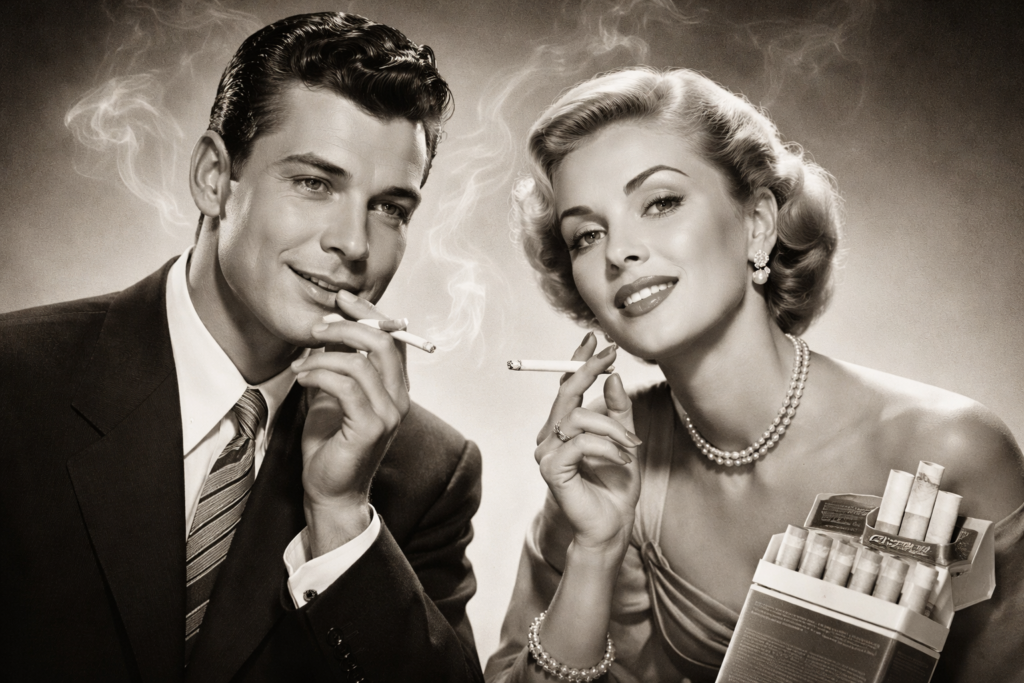
They funded research designed to produce inconclusive results. They recruited scientists willing to cast doubt on the emerging consensus. They ran advertisements featuring doctors endorsing cigarettes. They appeared before Congress and stated, under oath, that they did not believe nicotine was addictive — a statement that their own internal research directly contradicted.
What The Documents Said
When the tobacco litigation of the 1990s forced the release of millions of internal industry documents, what they revealed was not ambiguous.
A 1969 internal memo from Brown and Williamson contained a line that became one of the most cited in the entire history of corporate litigation. It stated that doubt is their product — since it is the best means of competing with the body of fact that exists in the mind of the general public.
This document became the defining evidence that the tobacco industry cover-up was not accidental negligence — it was deliberate strategy.
They were not trying to find the truth. They were trying to manufacture uncertainty about a truth they already possessed.
Internal research documents from multiple companies throughout the 1960s and 1970s showed detailed knowledge of nicotine’s addictive properties. Marketing documents from the same period showed strategies specifically targeting young people — getting them addicted before they were old enough to make fully informed decisions about the risks.
One internal document discussed the ideal age to capture a new smoker. It was not eighteen.
The Scale of What Was Known and Ignored
Between 1950 and 2000, an estimated 10 million people died from smoking-related illness in the United States alone. Globally the figures are vastly larger.
During that period the tobacco industry spent hundreds of millions of dollars specifically to delay the public understanding of what their own scientists had already established internally.
The strategy worked for decades. The manufactured uncertainty created genuine public confusion. Congressional hearings went nowhere. Warning labels, when they eventually arrived, were negotiated down in language and placement. Every year of delay — every year in which the public debate continued while the internal certainty was suppressed — translated directly into years of continued sales and continued deaths.
The executives who made those decisions largely died wealthy and untouched by criminal prosecution. The legal settlements that eventually came were civil, not criminal, and were absorbed by companies large enough to treat them as a cost of doing business.
The full scale of the tobacco industry cover-up becomes clear only when the timeline is laid out completely — decades of internal certainty alongside public denial.
Why This Pattern Didn’t End With Tobacco
The tobacco industry’s playbook — manufacture doubt, fund contradictory research, use legal privilege to suppress internal findings, maintain public uncertainty about privately established fact — did not disappear when the tobacco documents became public.
The same strategic framework has been documented in industries ranging from fossil fuels to pharmaceuticals to processed food. Internal research establishing health risks. Public communications designed to create uncertainty. Funding of scientific studies designed to produce ambiguity rather than clarity.
The difference is that tobacco’s documents are now public. For many other industries, those documents are still in the filing cabinets. Still protected. Still waiting.

What It Actually Means
It’s easy to read stories like this and locate the wrongness entirely in the past — in the specific people, the specific companies, the specific era. It’s more uncomfortable to recognize what it actually demonstrates about the relationship between institutional interest and public information.
The people who wrote those memos were not monsters in the conventional sense. They went home to their families. They gave to charities. They sat in meetings and made calculated decisions about what information the public should have access to and concluded, repeatedly, that the answer was less.
The capacity for that decision — the institutional capacity to know something is causing harm and choose continued profit over disclosure — has not been removed from the world. It has simply moved.
The memos from whatever industry is currently making that calculation are being written right now.
They just haven’t been released yet.
The tobacco industry cover-up left a specific legacy beyond the deaths and the lawsuits — a strategic blueprint that other industries have followed with remarkable precision.
The Dark History archive — the stories that took decades to surface and the ones still waiting.
**Sources & Further Reading**
Truth Tobacco Industry Documents — UCSF public archive [Industry Documents Library]- (https://www.industrydocuments.ucsf.edu/tobacco)
Tobacco industry history and health impact overview [American Cancer Society]- (https://www.cancer.org/research/surveillance/tobacco.html)